
Teaching

|
|
Teaching
|
|

The cell
as an integrated system - Dynamic
equilibrium, the tasks of the cell,
the cell as a thermodynamic
system, the cell as a chemical
system, exchanges across
the membranes of gas
and solutes (Fick's
law, passive diffusion, facilitated
diffusion, diffusion controlled,
primary
and secondary active transport),
homeostasis, regulation of
cellular functions.
Gas laws and their applications
The ideal gas law: Boyle's Law,
Charles's Law or of
Gay-Lussac's, second law
of Gay-Lussac's
or Law of Avogadro; Dalton's
law; Law of Graham;
Henry's law; Laplace's law
applied to the pulmonary alveoli.
Compartments and water
homeostasis
- The great water
compartments: the extracellular
and the intracellular compartment.
Methods used for the determination
of their size and
volume. Exchanges of water
and electrolytes through
biological membranes. gradient
concentration and electrochemical
gradient.
- Osmotic pressure: definition,
measurement units, plasma value.
The physiological solutions,
isotonic and isoosmotic,
and their use. The colloidoosmotical
and oncotic pressure:
plasmatic value and its
fluctuations.
Consequences of changes in
plasma oncotic pressure. The
balance of water and salts.
Principles of Hemodynamics
and Hemorheology
- General remarks on the
movement. Entities and speed
of flow in various areas of
the vascular system.
- Blood Flow: Physical
factors that influence blood
flow. Bernoulli's principle and
piezometry. pressure, resistance
and flow: the
law of Hagen-Poiseuille.
Viscosity: the relationship
between viscosity and
hematocrit. Turbulence. law
Laplace applied to arterial
vessels. Closing criticism
of
the arteries. Laplace's law applied
to
the capillaries.
- Characteristics of the vessels:
General Characteristics of the arteries,
capillaries and veins.
Ion channels and membrane
potential
- Ion channels: voltage-gated
ion channels (sodium, potassium,
calcium, chlorine), chemiodipendenti
channels, channels
mechanosensitive, patch clamp,
channelopathies.
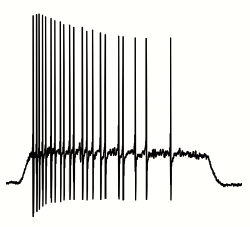
- Excitability Cell:
Polarization of the cell membrane
(ion distribution to the two
sides of the membrane and
its
genesis). Characteristics and
genesis of the potential
(membrane potential, graded
potential, potential miniature
action potentials). Technique
for the derivation of the
bioelectrical events. Repolarization
of the membrane, cycle excitability
and extent of
membrane excitability. Methods
for the electrical stimulation of
excitable tissues. Current types
and parameters of
the
stimulus. Law of "all
or
nothing". The conduction of
excitation along the excitable
membranes.
Propagation point to point and
saltatory conduction.
Synaptic transmission
- Interaction between excitable
elements. The transmission
of excitation at the synaptic
level. Chemical and electrical phenomena
in the synaptic
region. The excitation
and inhibition. Synaptic
integration. Neuromuscular junction
transmission
synaptic activity in the CNS.
- Neurotransmitters: Chemical
mediators (transmitters) and their
recognition. Liberation and secretion
of neurotransmitters, neurotransmitter
cycle, the cycle of synaptic
vesicle
- Ionotropic and metabotrobics
receptors, and synaptic
plasticity
Synaptogenesis, Hebb's
law, short-term and long-term
plasticity (long-term
potentiation and long-term
depression)
The nervous system: general information
- Changing sensory information in
bioelectric event. Receptors:
classification, mode of
operation and adaptation.
The information encoded as
a sequence of discharge. The
nerve fibers. The neuron as
a morphological unit, functional,
biochemical and trophic nervous
system. The assoplasmatic flows
The glia. The
synthesis of myelin both
at central and peripheral level.
Skeletal muscle and visceral.
- Skeletal muscle. The
sarcomere and the contractile
mechanism. Muscular energy.
Muscle fatigue. Isometric
and isotonic contraction.
Length-tension diagram.
Shock simple, muscular
tetanus. Production of calories.
the muscle work, muscle
performance. Metabolism during
and
after muscle contraction. Innervation
of the
skeletal muscles. Electromyogram.
- Smooth muscles: structure,
contraction mechanism, regulation of contraction,
biomechanics.